For many B2B marketers, one thing has become abundantly clear: Account-Based Marketing (ABM) is hailed everywhere as the ultimate technique for superior marketing results. Major software vendors and agencies throw around impressive statistics and promise the earth. But when you, as an SME+ business, try to apply those traditional, often American, enterprise theories to your European target audience of 20 to 100 ideal customers, you quickly run into a few problems.
Why? Because traditional ABM theory simply was not built for the scale, budget and firepower of the SME+.
Fortunately, there is a way to make Account Based Marketing work for your B2B business without overburdening your team or burning through cash. The key lies in a smart redefinition of the theory: our unique Sqrl method.
In this article, we take a deep look at the real benefits of Account Based Marketing for B2B companies. We start with the traditional benefits that other ABM providers keep repeating, and then show how the unique Sqrl method redefines those benefits for unbeatable results for the SME+.
What actually is account based marketing?
Account-Based Marketing (ABM) is a B2B strategy in which you direct your marketing and sales efforts not at the broadest possible, vaguely defined audience, but at a pre-selected list of specific companies (accounts) that are the best fit for your business. You treat each account, or a cluster of similar accounts, as its own small market. Rather than casting a wide net and waiting to see which loose leads trickle in, you deliberately choose who you want to do business with and tailor your messaging, content and follow-up accordingly. The term was coined back in 2003 by research firm ITSMA and has become increasingly important for B2B companies, because the way their customers find and select suppliers is changing. They need a new approach to keep their sales pipeline full.
What are the traditional benefits of account based marketing?
At its core, ABM shifts the commercial focus from quantity (as many loose marketing leads as possible) to quality (the right accounts). Rather than firing at anything that moves with traditional inbound marketing, you aim exclusively at a pre-defined list of ideal customers.
Before we dive deeper, here is a clear overview: for each traditional benefit, you can see what the enterprise theory promises and how we deliver on that promise with the Sqrl method for the SME+.
| Traditional ABM benefit | The Enterprise theory | The Sqrl method for the SME+ |
| 1. Personalisation | Bespoke content for every individual account. | Efficient personalisation through segmentation per cluster (1:cluster). |
| 2. Alignment | Large, slow and complex ‘Smarketing’ committees. | An agile Business Development Team that meets regularly. |
| 3. Sales cycle | Promises a shorter cycle from day one. | Smart timing within long, existing contract terms. |
| 4. Higher ROI | High ROI through massive budgets on a handful of mega-accounts. | High ROI through sharp focus, without unaffordable overhead. |
| 5. Budget (zero waste) | No waste thanks to extremely precise targeting. | No waste: nurturing only starts once an account shows intent. |
| 6. Retention & expansion | ‘Land & Expand’ within enormous top-tier accounts. | Staying structurally top-of-mind across your entire cluster, including existing customers. |
| 7. Reporting | Often a ‘black box’ where you only see ROI after the fact. | Live, integrated visibility of all touchpoints through a single platform. |
Quick menu: The 7 traditional core benefits of ABM
- Higher Return on Investment (ROI)
- Optimal Sales & Marketing Alignment
- Efficient budget use (‘Zero Waste’)
- Shorter sales cycle (Sales Cycle Length)
- Better customer experience through personalisation
- Account retention and expansion (‘Land & Expand’)
- Better measurability and clear attribution
Want to skip straight to the Sqrl method benefits for SME+ businesses? Click here.
1. Higher return on investment (ROI)
Virtually every international B2B marketing study confirms that ABM delivers a higher ROI than other forms of marketing. The most widely cited figure comes from research firm Momentum ITSMA, the organisation that originally coined the term ABM: 81% of marketers who actually measure their returns say that ABM outperforms every other marketing strategy. The logic is straightforward: because marketing spend is not spread thinly across a broad audience but concentrated on the accounts with the highest potential deal value, the return per pound invested is simply far greater.
2. Optimal sales and marketing alignment
In traditional marketing, friction is the norm: marketing celebrates a flood of whitepaper downloads while sales complains that those leads are cold and never convert. ABM forces both departments to work together from day one. They jointly define the Ideal Customer Profile (ICP) and the Target Account List (TAL), making commercial objectives crystal clear and eliminating any debate later on about what a good result actually looks like.
This is such an important subject, we’ve written a full article about Sales & marketing alignment in account based marketing that elaborates on how this is a key factor for ABM success.
3. Efficient budget use (‘Zero Waste’)
Because the target audience in ABM is defined with extreme precision upfront, there is virtually no marketing waste. You stop advertising on platforms where you happen to reach ‘everyone’ and instead show your messaging exclusively to the Decision Making Unit (DMU) of selected accounts. This significantly reduces your Customer Acquisition Cost (CAC).
4. Shorter sales cycle (sales cycle length)
A typical B2B buying journey takes a long time because so many decision-makers are involved. In traditional lead generation, a single contact usually comes through the door, after which sales has to manually convince the rest of the organisation. ABM targets the entire Buying Centre simultaneously. Because the financial controller, the IT manager and the managing director all see relevant content at the same time, internal objections within the prospective customer’s organisation are overcome more quickly.
5. Better customer experience through personalisation
B2B buyers now expect the same personalised experience they get as consumers. McKinsey found that 71% of buyers expect a personalised approach and 76% become frustrated when it is absent. Because marketing immerses itself in the specific challenges and sector of a target account, the content, ads and emails align seamlessly with their world. This boosts engagement and conversion rates.
6. Account retention and expansion (‘Land & Expand’)
Many enterprise organisations use ABM for account expansion. Through the ‘Land & Expand’ strategy, you open doors to other subsidiaries or departments within an account you have already won, maximising Customer Lifetime Value (LTV). On top of that, the focused, relevant attention builds structurally stronger customer relationships: B2B buyers value a partner that truly understands their business, and that lays the foundation for a long-lasting partnership.
7. Better measurability and clear attribution
When you look at individual leads, it is often difficult to prove which marketing campaign was responsible for the deal. ABM looks at accounts instead. By measuring how an entire account moves through the funnel, from the first LinkedIn click to the demo request, marketing attribution becomes crystal clear.
Why standard ABM theory falls apart for the SME+
So much for the textbooks. Reading the Account Based Marketing benefits listed above, you would want to start tomorrow. Yet in practice, this is precisely where things go wrong. Major platforms such as HubSpot, Salesforce and Demandbase write their content for enterprise giants, not for SME businesses.
The prevailing ABM theory comes in roughly three flavours. In 1:1 ABM, you treat a single account as an entire market and build a fully bespoke programme designed to win a handful of mega-accounts with million-pound budgets. In 1:few ABM, you target a small group of similar accounts (always fewer than 20) simultaneously. And in 1:many ABM, you go after hundreds or thousands of accounts, which in practice often amounts to disguised inbound marketing (lead generation). The enterprise playbook almost always prescribes either the costly 1:1 approach or the diluted 1:many version. SME+ businesses with a target list of 20 to 100 accounts fall squarely through the cracks:
- The overhead trap: building 1:1 hyper-personalisation for 50 individual accounts is unaffordable. Your marketing team will most likely buckle under the workload within a month.
- The contract reality: in sectors such as mechanical engineering, professional services or automotive, businesses do not switch suppliers every year. If an account is locked into a 3-year contract, no traditional ABM campaign is going to magically shrink that sales cycle to three weeks.
Blindly copying the enterprise approach creates an unworkable situation, friction between teams and a frustrated leadership team. And that is exactly why we developed the Sqrl method, so that SME businesses can make ABM work for them too.
The real ABM benefits for the SME+: the unique Sqrl method
We believe that ABM for the SME+ does not have to be complicated, unaffordable or enormously time-consuming. By redefining the traditional Account Based Marketing benefits, the Sqrl method delivers maximum commercial returns without unnecessary overhead.
Sqrl steps outside that three-way split entirely. Instead of sorting your list into three tiers and running three different playbooks in parallel, we use what we call a 1:cluster approach: one model for the whole list, not a compromise wedged between the other two. When building the Target Account List, we group accounts based on their dominant shared characteristic. Think of a specific market or sector, a typical product use or application, the type of company or its ownership structure. Businesses within such a cluster almost always wrestle with similar concerns, challenges and problems. Every account gets the same relevant, cluster-specific campaign, whether it would have been flagged as a Tier 1 mega-account or a Tier 3 afterthought under the classic model. That is what lets us communicate in a highly relevant and concrete way with the entire group, without creating separate content for every individual account, and without needing three parallel programmes to pull it off.
1. Operational efficiency through our unique dual-track approach
Where traditional ABM demands that you create bespoke content per account from the very start, Sqrl opts for a smart, scalable dual-track approach:
Track 1: The ‘Intent’ track (Always-on). We focus on a single cluster with similar challenges. Think of a gearbox supplier targeting the food processing industry, or an automotive player targeting construction companies with 10 to 50 vehicles in their fleet. We continuously build brand awareness and visibility. By constantly analysing click behaviour and website visits (the touchpoints), we pinpoint exactly which accounts are showing active interest right now and are ready for a more personal approach.
Track 2: The ‘Nurturing’ track. Only when an account shows this intent does Sqrl activate the intensive nurturing process. We map the account’s full DMU (Decision Making Unit) and engage those individuals through a targeted step-by-step plan.
The Sqrl advantage: you do not need to move mountains upfront for 100 accounts. Your marketing team focuses its personalisation and energy exclusively on the accounts that are warm right now. And these are also the accounts where you see results first. That is something both sales and the leadership team can get behind.
2. Efficient personalisation through micro-segmentation
Where the enterprise theory proclaims that the benefit of ABM lies in hyper-personalisation (bespoke content for every individual account), we redefine this benefit for the SME+ as efficient personalisation through micro-segmentation. Because an entire cluster faces the same challenges, the right message for one company works just as well for the rest of the cluster. You get the relevance of personalisation without the unaffordable overhead of bespoke work per account.
This aligns seamlessly with what the market expects. The McKinsey research mentioned earlier shows that the vast majority of buyers expect a personalised approach and will disengage without one. The Sqrl method goes a step further than relevant content alone: we only approach someone in the DMU personally when the intent track shows that the topic genuinely matters to them at that moment. As a result, the customer does not experience unsolicited sales pitches but a relevant conversation at exactly the right time. That boosts not only engagement and conversion, but above all the customer experience.
3. Genuine alignment: the Sqrl Business Development Team
Rather than forming vague committees, Sqrl brings sales and marketing together in one compact Business Development Team from the outset. In the very first week, we jointly define the Target Account List and agree on exactly when an account earns the label Sales Qualified Lead (SQL).
Sales owns the process from the start and carries out targeted actions within Track 2 as well. The result? Account managers do not receive cold leads thrown over the fence; instead, they pick up warm conversations in which the DMU already knows the brand. This leads to a significantly higher conversion rate and shorter introductory meetings.
4. Strategic timing within long B2B sales cycles
In the B2B world, supplier contracts (for services such as CNC machining or professional services) can run for 3 to 5 years. Your prospective customer simply has to be at the right point in that cycle.
The Sqrl method solves this. Our always-on brand awareness campaign (Track 1) ensures you are structurally top-of-mind the moment a contract with a competitor expires. At the same time, the intent track lets you capture the ‘early wins’ from accounts that are actively in the market right now. No marketing spend wasted on accounts that cannot buy yet, but scaling up the moment the data shows there is something to go after. Better for the account, too, by the way: who wants to be on the receiving end of a hard sell when they cannot buy anything?
5. Higher ROI through sharp focus
The most tangible benefit for the SME+ is focus. Many SME+ businesses define their market too broadly and target anyone who could potentially become a customer. By deliberately choosing an ideal cluster, your solution genuinely matches the prospective customer’s need. The result: your marketing spend is not diluted across a vague mass but concentrated on the accounts with the highest probability and deal value. That explains why ABM, when executed sharply, consistently delivers a higher return (the 81% from the ITSMA research). And the good news is that you do not have to wait years for those returns. In practice, we often see the first quote and contact requests from the Target Account List come in within the first few months, purely on the back of the broad visibility campaign. Prospective customers recognise the relevance straight away.
Want to learn more about calculating the ROI of account based marketing? You should read our full article about this subject.
6. Account retention and growth: Land & Expand for the SME+
The enterprise theory uses ‘Land & Expand’ to tap into new departments and subsidiaries within enormous top-tier accounts. For the SME+, we translate this benefit to the reality of your own cluster. Your always-on intent track does not stop once an account becomes a customer: you remain structurally top-of-mind across your entire target audience, including your existing customers. Through the same touchpoints, you spot when an existing customer develops renewed interest or expansion needs, so you can respond proactively. The result is higher customer value over time (Customer Lifetime Value) and stronger, longer-lasting relationships, without having to build a separate, costly expansion programme.
7. Integrated measurability and boardroom confidence, thanks to the Sqrl software
Many SME+ leadership teams are wary of marketing investments because traditional programmes often feel like a ‘black box’: you pour money in based on hope, and only hear months later whether it delivered anything.
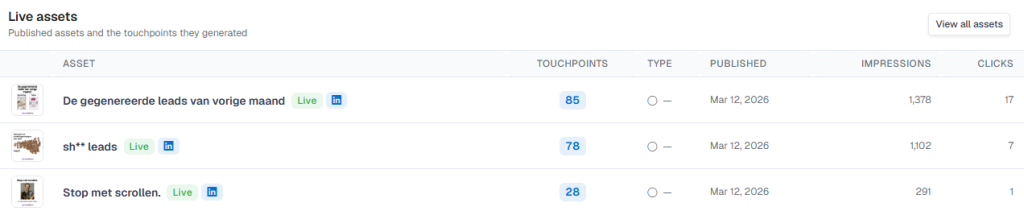
Sqrl eliminates this uncertainty, and the difference lies in our own software. Where others have to manually piece together their reporting from separate tools (an ad platform here, a CRM there, an analytics dashboard somewhere else), the Sqrl software pulls all ABM activity together on a single platform and reports on it holistically. Every interaction is recorded live and linked to the right account: how many people from each specific account saw which LinkedIn ad, who visits the website and who attends an event.
This means marketing no longer has to wave vague ‘likes’ around; it can show the leadership team progress in black and white (pipeline velocity). This visibility provides confidence, certainty and hard evidence that the commercial team is on track towards the ultimate conversion.
A screenshot from one of our own campaigns, showing how we track the performance of different LinkedIn ads within our target audience.What does ABM cost, and when can you expect results?
ABM is not a switch you flip for leads tomorrow. It is deliberately a long game, because B2B sales cycles (think again of CNC machining or medical packaging machinery) can easily span 5 to 10 years. Once a business has a supplier in place, it does not switch every year.
At the same time, you see results sooner than most people think. We typically launch the brand awareness campaign around week 5, and in the first few months we often see the initial quote and contact requests come in from the Target Account List, purely on the back of that broad visibility.
In terms of budget, the benefit lies in protection and focus. By only activating nurturing once intent has been demonstrated, you avoid wasting budget on accounts that are locked into a contract for years to come. If a business only shows intent after nine months, we add it to the nurturing track then; doing so earlier would simply have been inefficient. Meanwhile, the always-on campaign steadily builds brand awareness, so you are top-of-mind precisely when the contract with their current supplier expires.
At Sqrl, you can get started with an investment from €4,500. We then guide your team through our unique methodology and software so you can run the campaign yourselves. Short on time or expertise? We can of course take more off your hands. We have a clear programme for that too. Want to find out more about working with us? Get in touch.
How do you measure these benefits? Essential ABM KPIs
To make sure your ABM strategy actually delivers the promised benefits, it is essential to steer on the right metrics. Within the Sqrl software, we do not focus on the flattering numbers that secretly contribute nothing to your business goals (vanity metrics), but on KPIs that are directly linked to commercial success:
- Account Engagement Score: what percentage of your list of 20 to 100 accounts is showing active touchpoints in Track 1?
- DMU coverage: in how many of the active accounts have the key roles (deciders, influencers, buyers) been successfully identified and reached?
- Pipeline Velocity: how quickly are accounts moving from the initial awareness phase into the active nurturing track?
- Win rate on the TAL: is the percentage of won quotes and meetings specifically within your Target Account List increasing?
Want to read more about the account based marketing KPIs that are most relevant for measuring success? We wrote a full article about just that.
When is ABM not for you?
Let’s be honest: ABM is not the right choice for everyone. Precisely because we believe in a targeted approach, we are upfront about when you are better off not starting it (yet).
- When your average deal or transaction value is low. If the typical contract is relatively small, the investment in a focused ABM programme often does not justify the return. A lead-based, higher-volume approach tends to work better in that case.
- When sales and marketing are not willing to collaborate. ABM stands or falls with the cooperation between both teams. They need to be open to a new approach and, quite practically, get along well enough to pull in the same direction. Without that foundation, it simply will not work.
- When you want leads to chase tomorrow. Need a stack of contact details to cold-call straight away? Then you might be better off responding to the spam messages that land in your LinkedIn inbox every day; there is no shortage of fast-moving entrepreneurs promising you exactly that. We believe in deliberately going after the ideal customers for your business, and that does not happen overnight.
- When your target audience cannot be clustered. The power of our approach lies in shared characteristics. If genuinely anyone could be your customer, with no common thread across market, application or company type, you lack the basis for efficient micro-segmentation.
- When you do not (yet) have a distinctive story. Being consistently visible to a select group only works if you have something to say that sticks. Without a sharp positioning, you are mainly just burning attention.
- When you are not prepared to measure. The entire benefit of control and boardroom confidence hinges on collecting touchpoints and intent data. If you are not willing to do that, you miss out on the lion’s share of the gains.
Conclusion: choose ABM that works for the SME+
The benefits of Account-Based Marketing are undeniable: higher ROI, perfect alignment between sales and marketing, and real grip on your most important target audience. But do not be seduced by complex, unaffordable enterprise theories that simply do not fit your organisation.
For the SME+, the win lies in a pragmatic, data-driven approach. With the Sqrl method and our purpose-built Sqrl software, you transform your list of 20 to 100 accounts into a predictable sales pipeline. No vast overhead, maximum results.
Ready to truly unlock the benefits of ABM?
Do not get stuck in the enterprise trap. Get in touch with the specialists at Sqrl today and discover how our unique dual-track approach takes your business development team to the next level, delivering tangible results: sales pipeline.